How I Would Market And Sell Web Development Services If I Were Still A Web Developer
In the web development business? Perhaps graphic design? Getting clients a real pain? This is how I would personally market a business like that.
In the web development business? Perhaps graphic design? Getting clients a colossal pain in the ass? 😉
I know the feeling.
Today, I operate the Blog Marketing Academy. Before this, I was a tech blogger. But at the same time, I was also a for-hire web developer. I did custom projects in PHP and created projects like a custom content management system, a fully-custom patient management system, an email reminder service… and a lot of smaller projects in between.
Most of those clients came from word of mouth. I was “lucky” to never completely depend on development for my income since I had the tech blog going at the same time. But I still wanted more clients. And getting them was a hard thing to do.
And here’s the funny part: I’m sort of back in the service business now. Through Concierge, I run a productized WordPress management service for solopreneurs. So even though I’m not labeling myself a web developer anymore, I’m doing real client work again. Just packaged completely differently than I would have back then. Different positioning. Different niche. But the playbook I’m about to walk you through? I’m walking my own talk on every piece of it.
And in 2026, getting service clients is harder than it has ever been.
Why It’s Harder Than Ever To Get Service Clients
We’re in a global marketplace where you’re now competing with people overseas who can easily undercut you on your rates. Plus, there are a lot of people out there who do this. So, the problem is that…
Web development is a commodity. Graphics design is a commodity.
And now… AI has joined the party. Tools like Lovable, v0, Bolt, Cursor, and Claude Code can spin up working sites in minutes. Your prospects know this. Some of them have already tried it. The commoditization story isn’t just about offshore developers and Fiverr anymore. AI is eating the bottom out of routine dev work entirely.
But here’s the part most developers miss: this doesn’t make you obsolete. It changes what people actually need from you.
Using AI in your own delivery isn’t optional anymore. Not to compete with AI on price, but to deliver faster and at higher quality than you could before. AI is your force multiplier, not your competition. If you’re not using it yet, you’re already behind.
What clients will still pay for – and pay well for – is the human on the other end. Someone approachable. Friendly. The one who actually responds when they email. The point of authority who can translate what they need into something real, and who knows what they’re doing when AI starts hallucinating or producing nonsense.
Because here’s the thing…
Your prospects ARE trying to use AI themselves. A lot of them are running into trouble. They don’t have the skills to keep AI from going off the rails. They can’t always tell when AI has done something stupid versus something clever. Sometimes they can’t even interpret what AI has done in the first place. They need someone who can.
THAT is your selling proposition in 2026. Not “I can write code.” Not even “I’m cheaper than the alternatives.” It’s “I’m the trusted human who knows how to get this done… with AI in the toolkit, but not as a substitute for craft and judgment.”
Plus, there’s the hassle of dealing with clients who look at you as a commodity.
- Some clients will expect huge projects out of you for chicken scratch money, and actually get rude with you if you don’t deliver.
- Some clients will take their sweet time getting back to you on stuff you need, then get rude with you when you don’t get back to them immediately.
- Some clients don’t even know what the hell they want in the first place.
Need I go on? 😉
It is easy to say that clients suck (and I’ve heard more than my share of service providers say that), but the truth is that much of that comes from the WAY you manage your business.
If you play in the sandbox of being a commodity, then you’re going to get treated like one.
The answer is to run your business a little differently.
So, if you’re a web developer or a graphics designer, I want to help you grow your business.
Let’s go over 8 specific business strategies I’d use if I were running a web dev or design business in 2026…
#1 – Don’t Hide Your Personality
I see a LOT of small business websites where they try to look a lot bigger than they are. They use “we” everywhere when it is really just an “I”.
Why hide who you are? It doesn’t make you look small-time to have your personality on your business site. You know what it makes you? HUMAN. And people want to do business with a person, not an anonymous “we”.
One of the most effective ways to not be a commodity is to inject your personality, because there is only one YOU.
And this matters more in 2026 than it ever did. AI can fake a brand voice. AI can write the copy. AI can generate the slick “About Us” page and even the headshot. What it can’t fake is the actual YOU… on a call, in an email, in a recorded video, replying to a comment. Lean into that. Hard.
#2 – Create Outcome-Focused Content
Service business owners often struggle with the notion of creating content for the purposes of marketing. One of the biggest questions is “What the hell do I blog about?”
Legit question. I mean, talking code isn’t exactly exciting reading. And boring as hell to write about, too.
What you need to do is put yourself firmly into the mind of the prospect you’re looking to serve.
What outcome do they want? What are the benefits they’re looking for? What would that mean for them?
For instance, perhaps you create custom website designs. Your client wants a web design, but why? If you deep dive on it, you’ll find the main benefits they’re seeking are:
- More money
- To look better than their competition
- To not have their site lose leads or sales
So, imagine the power of a content item which compared two business websites… one which sucked and the other which was done professionally. Show them EXACTLY what you would change and why. Talk about the real-world results of the better design. Record it in a video. Under the video, include a call to action.
Now you’re talking about stuff you can do, but in terms your prospect cares about.
#3 – Stop Saying “Contact Us” All The Time.
Most service provider websites have as the only call to action to fill in some contact form. Something like…
“If you’re interested in a free quote, contact us”
… and then this extremely impersonal form for them to fill out.
That call to action will only possibly be relevant to the hottest kind of lead… the person who is actively looking to buy right now.
See, your leads go through certain phases…:
- Not Looking. These are people who could likely use your service but don’t know it.
- Thinking About It. These are people who are thinking they might want to hire somebody like you. They’re not ready to take any action, but they’re just… thinking about it.
- Engaged. These are people who are actively shopping for what you offer.
- Need. These are people who need what you sell and they need it now.
Most of the world is in the “not looking” phase. These people will likely not visit your website unless you specifically have marketing in place to attract them. More on that in a bit…
Some people are “thinking about it”. These people might be seeking out information. Or they may be looking for something to put them over the edge and decide to pull the trigger on it. If your small business website has nothing to cater to these people, then you fall flat.
A few people will be “engaged”. This kind of prospect may very well end up on your website, depending on what kind of prospect outreach you’re doing. But, then they see that generic small business website, perhaps a portfolio page, and a generic “contact us for a quote” call to action. To them, YOU BLEND IN.
And very few people are in active “need”. The way to get these people is to have them be aware of you BEFORE the need arises.
So, I hope you see that the standard “contact us for a quote” call to action is extremely weak and ineffective for almost all kinds of leads.
If you have that, you’re being a commodity. So, what do you replace it with?
More on that in a minute…
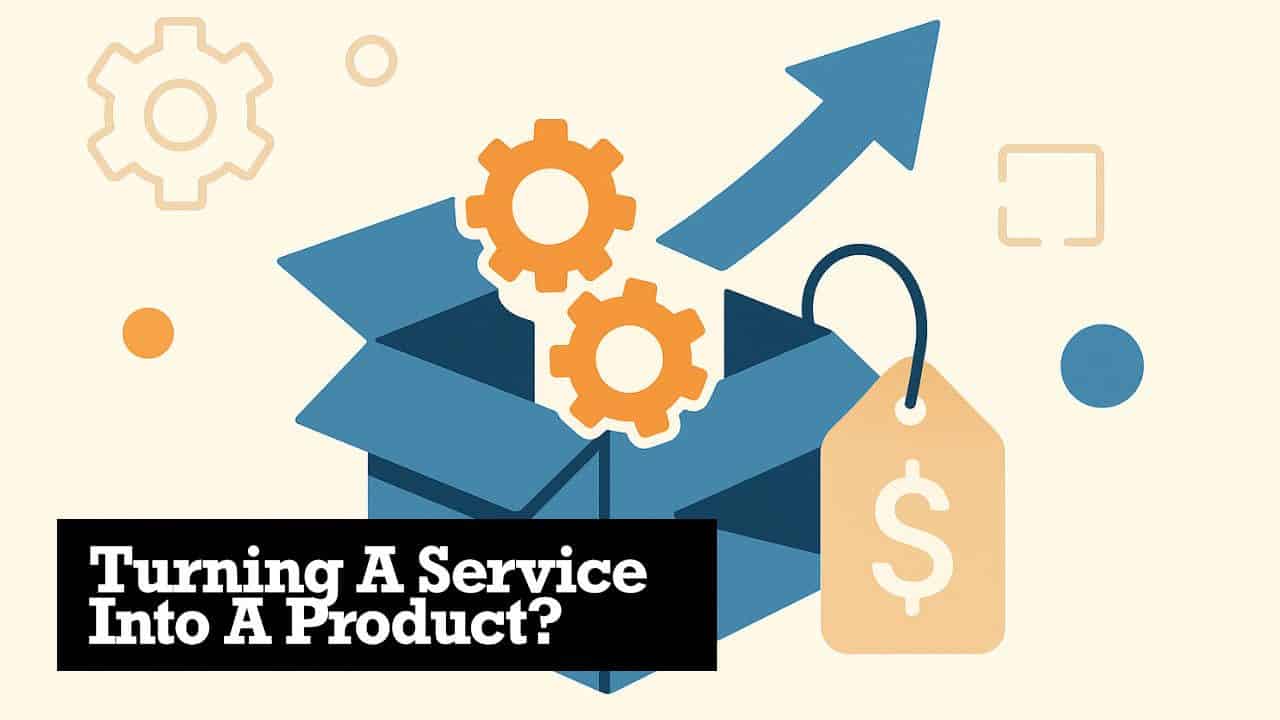
#4 – “Productize” Your Offer
The other problem with “contact us for a quote” is that it is incredibly open ended and vague. They don’t know what kind of ballpark pricing to expect. In fact, to them, asking for a quote probably just says you’re expensive and they’ll bypass you.
So, instead of just being some kind of general hourly developer, or a fully custom service provider, how about you turn some of your services into packaged products and sell them that way?
This will allow you to set up your offers into funnels and lead magnets. More on that in a bit, too. 😉
For example, Concierge… what I run now… packages WordPress management into tiered subscription plans rather than custom-quoted hourly work. Same kind of work; completely different offer structure.
#5 – “Systematize” Your Delivery
Most smaller custom service providers run their business and their delivery by the seat of their pants.
Every project is different. Every quote is different. Every client is different. Every day is different.
But, you can’t grow a business like that. You’ll be constantly feeling as if you’re just barely catching up.
So, systematize the hell out of it. (It’s how Concierge can scale at all… every recurring task is either a documented process or a script that runs itself.) Turn the things you do into processes that repeat and document them in checklist format. Boil your projects down into particular phases that are consistent with all of them. Find anything you often have to repeat and turn it into a checklist and/or find a way to automate it.
Here’s what this will do for you…
- It will provide consistency of delivery to your clients.
- It will improve your efficiency so you can deliver more during work hours.
- It will provide clarity to your clients and your prospects.
- It will reduce those weird random client requests that don’t seem to fit into anything.
- It will allow you to better “productize” your offers, per above.
This is also where AI becomes a real force multiplier. Tools like Cursor and Claude Code can compress hours of repetitive dev work into minutes when they’re plugged into a systematized workflow. The key word is workflow. AI without process is just a faster way to make a mess. Build the system first, then layer AI in to accelerate it.
#6 – Set Up Actual Sales Funnels
Sales funnels don’t apply only to info products. It is a universal concept. And, you know what isn’t a funnel?
VISITS WEBSITE —> Contact for Quote
That’s not a funnel. It’ll rarely ever work unless that person was pre-sold before they got there.
A full funnel looks like this:
- Lead Magnet
- Front-End Offer
- Core Offer
- High-End Offer
Now, if you’re in the custom development business, you’re in a position to re-position what you do into funnels. This is how productizing and systematizing delivery comes into play.
A lead magnet is supposed to get people to become an email lead. Yes, you want prospects on your email list! And you do NOT want to depend on just a dumb quote form to get them. You want to be able to capture people in the other lead phases (see above) and not have a website which completely drops the ball on the vast majority of potential leads there are out there.
The job of the front-end offer is to turn people into a customer – at any level. Look at it as a qualifier. A front-end offer isn’t supposed to be the main focus of your business. It is just how you get customers in the door. Think about how an auto mechanic might offer a cheap oil change and a free A/C check. That’s not their core business, but it gets customers in the door!
Then the core offer and high-end is where you begin making your money. That’s where the big design projects, or the custom websites happen.
So, here’s a potential sales funnel I might explore if I were in the business of creating custom sites for clients.
- Lead Magnet – Invite them to opt-in for a free website evaluation checklist. They get it as a free download, perhaps with a video explaining how to use it. This checklist will open their eyes to the “holes” with their existing site and most likely raise them up the lead phases to the next level.
- Followup Emails – By getting that lead magnet, they’re now on your email list. So, FOLLOW UP. Automatically. This is something you automate via an email list provider. Send them a series of emails regarding that checklist. Did they fill it out? What were the results? “Gee, if you want to know more about the effects of improving this aspect of your site, go look at this article.” Do this in a series of automated emails over time.
- Front-End Offer. Take a productized service and offer it as a front-end offer in your funnel, priced such that it gets their attention. Like, a logo for just $99.
- Core Offer. “You know, you don’t want to put that snazzy logo onto some crappy site where it looks out of place, do you? I can do X, Y and X for you to have a new site built for you, for $499.” (Note, you obviously price this at something that makes sense for you, and you strip down the service to accomodate.)
- High-End Offer. This is where your custom stuff comes into play. By this point, you’ve done some work for them. They’ve gotten results. They trust you. By this time, if they need custom work done, a quote is probably a mere formality. They’ll hire you because they know you.
You get it? 🙂
In most cases, all you’ll need to do is take the stuff you already do for your clients and simply RE-POSITION it into products you can sell and into a funnel which properly accommodates the different lead phases.
#7 – Productize Toward Certain Audiences
Another huge problem with the standard small business website (with a portfolio, a generic about page, and a quote form) is that it is so generic that it applies to nobody.
What you WANT people to think when they see your offer is that YES, it is indeed what they’re looking for. And you can do that by re-packaging and re-positioning for different markets.
For instance, if you’re in the lawn maintenance business and need a new website, what will jump out at you most?
- “We make great websites. Contact us for a quote”.
- “We create sites for lawn businesses that have been proven to get new clients. Opt In Here to see our 7-point Checklist For How to have a lawn business website which converts!” (and of course, they opt-in and they’re in your sales funnel).
Obviously, the second one will work better. It directly speaks to the target audience: lawn maintenance businesses.
This makes your generic offer suddenly APPLY to people who would otherwise never pay any attention.
You can also do this through areas of focus. For instance, what if you had a landing page specifically for people who need a membership site built? This page would be custom written to apply to membership sites. That’s guaranteed to work better than just randomly hoping a person interested in that comes across your generic services page.
#8 – Do Guerilla Marketing
Get down in the trenches. And reach out to prospects but not in a way which turns you into a commodity.
For instance, if you’re trying to get clients by competing with the world on Upwork or Fiverr, you’re probably pretty freakin’ frustrated.
But, what if you singled out a particular business in your local area? You then find that person’s email address. Fire up Loom (or whatever screen recorder you like) and record a short custom video… just a few minutes long… that critiques their current website and shows them the opportunities they’re missing with it.
That’s not an email they get everyday! It will almost definitely open their eyes. You just made clear to them how their current site is losing them money. And you’ve got their attention in their email inbox.
Boom. Sold. 😉
That’s It For Now…
I hope it is very obvious that the kind of marketing I teach here isn’t just for internet marketers or information product creators.
It works very well for service businesses…. even local, small ones.
In fact, the results would probably be pretty stellar because I can almost guarantee you that your competition in your area isn’t doing any of this.
This is how you stop being a commodity. And honestly? These are exactly the kinds of things I’m doing now myself through Concierge. Not custom web dev anymore, but a productized service business built on every one of these principles. So it’s not theoretical.

David Risley has been building on the web since 1998 and founded Blog Marketing Academy in 2008. After years helping bloggers and online entrepreneurs grow their businesses, he now runs Concierge — a done-for-you WordPress management service for membership sites and online businesses. He manages hosting infrastructure, handles the technical heavy lifting, and keeps client sites running at peak performance. Click to read his full origin story.